“IN A GLASS DARKLY”
Over 60 minutes of ambient sound to use for your Sci-Fi themed roleplaying, board games, card games, or reading.
This collection of ‘scapes is an homage to science-fiction of the 20th century. Its origins lie in my personal deep and abiding affection for such inventions – ranging from stories by H.G.Wells and Jules Verne, through films like “Forbidden Planet” and on through the decades via Arthur C. Clarke, the early “Star Wars” movies, William Gibson, Manga classics such as “Akira”, and the sprawling multi-faceted universe of mega-franchises such as Warhammer 40K.
The six tracks are available individually in MP3 format on this page, and also as a YouTube video of the entire work accompanied by Milkdrop generated visualisations :
Tracks
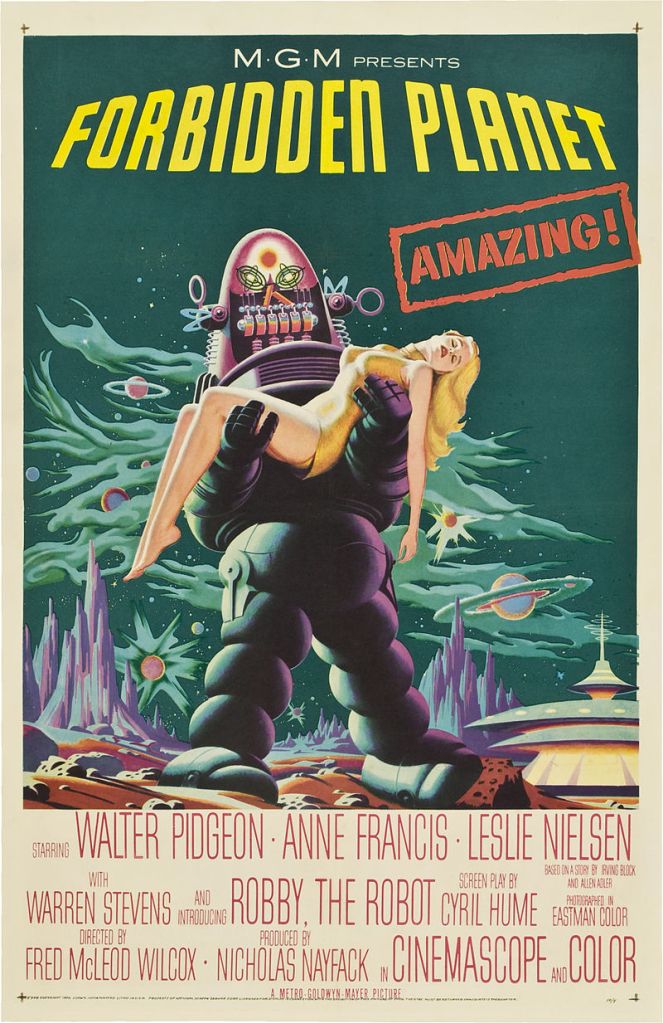
01 “This Door Is Forbidden”
A nostalgic piece inspired by “Forbidden Planet”. This is the film I saw as a young person that not only entertained me as a well crafted science fiction story, but (perhaps for the first time in such a context?) really made me think – about potential future technological advances, about the nature of homo sapiens, our amazing strengths – and terrifying weaknesses.
The visualisation I chose was an attempt to try to connect back to the kind of sounds possible in 1956 using only ring modulators and tape machines.
02 “In Tenebris Eterna”
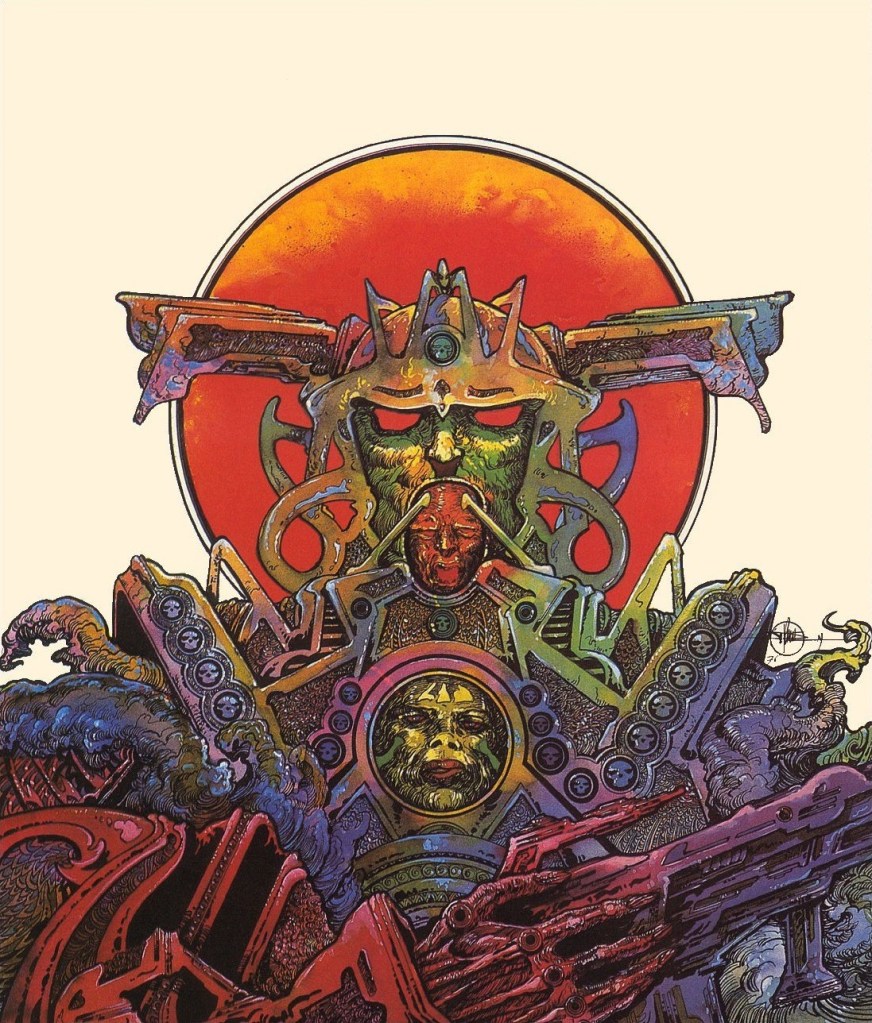
(Trans: “In Eternal Darkness”). A choral piece inspired by the mind-expanding graphic novels of Philippe Druillet. In the preface to “Lone Sloane: Gail” Druillet writes: “Let the darkness be nothing but the chiaroscuro which highlights the beauty of things, as well as the most precious good: LIFE! A fight to be led by all.”
The accompanying visualisation is rooted in Druillet’s portrayals of chaotic alternative planes of existence where all human perspectives fail.
03 “The Shepherd Of Being”
Martin Heidegger was an influential philosopher of the 20th Century. His approach was essentially pre-ontological – which is to say, asking not “Why do things exist?” but rather, “What does it mean to be a kind of entity that can ask ‘Why do things exist’ ?”. My track title is a play on words – it is a quote from Heidegger’s work, but also referencing a special sort of sonic trickery that I have employed in this track, called a Shepherd Tone, after its inventor Roger Shepherd.
The visualisation for this track is intended to be both abstract and “cosmic”.

04 “Kyrie Eleison”
(Trans: “Lord, Have Mercy”). This soundscape was meant to evoke the Ecclesiarchy as portrayed in the popular far-future universe of Warhammer 40K. To quote Chris Morgan :
“The idea that the Imperium is solely a caricature of religion, and that religion only is fundamentally responsible for the death, ignorance, and oppression of all societies across history only grazes the edges of what is a wider human problem.”
The visualisation was intended to reflect the terrifyingly insane roiling currents and eddies of energy in the psychic dimension which 40K lore identifies as “The Warp”.

05 “To Sense The Heliopause”
Imagine a place 15 billion miles away from Earth. A spacecraft venturing out of a solar system, slowly rising up out of the plane of the ecliptic into the ultimate darkness of the space between stars. Such is the current condition of NASA’s Voyager 1 – still fulfilling its mission directives after 45 years.
The visualisation for this piece is a nod to the “light-vortex” effect used to represent travel through a “stargate” in the film “2001 – A Space Odyssey” (1968).

06 “Ghosts In The Machine”
A tribute to William Gibson‘s seminal 1984 novel “Neuromancer”, which launched cyberpunk as a genre. The title evokes both Arthur Koestler‘s philosophical work “The Ghost In The Machine” in which he (like Heidegger) rejects the Cartesian dualism of mind versus body, and also the Seinen Manga cyberpunk triumph that is Masamune Shirow’s “Ghost In The Shell”.
The visualisation for this track is purely abstract – I just liked the colours!
TECHNICAL NOTES
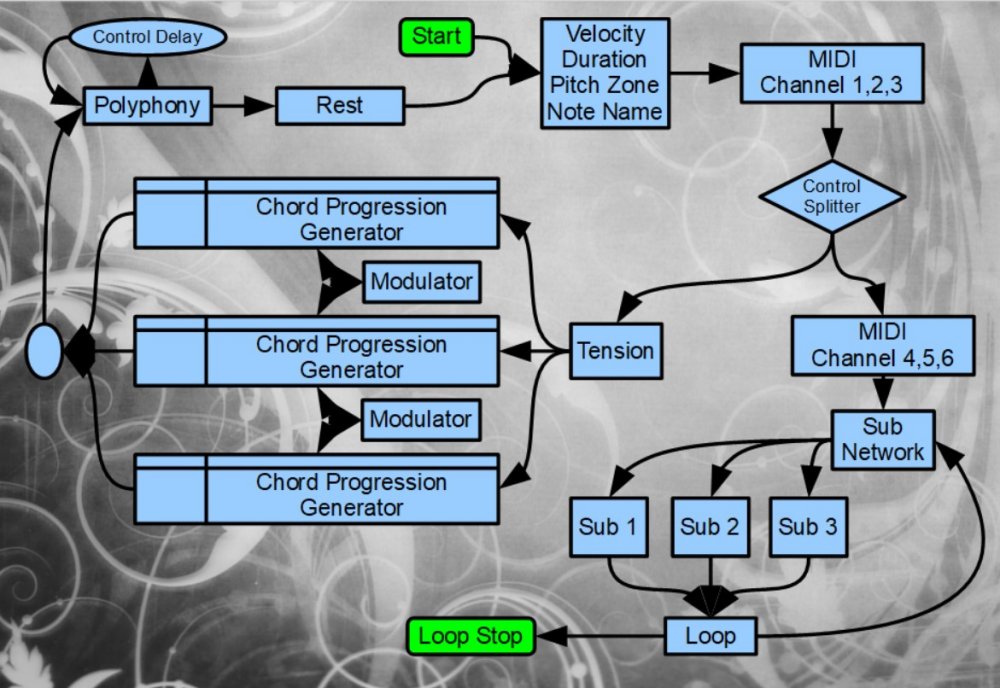
As usual, much of the composition for this work involved my favoured network sequencer, Nodal.
I used multiple variants of a highly tunable network of my own design – incorporating a weighted histogram basis for random selection of properties such as note name, note length, note velocity, and keyboard section. A “tension level” selector chooses a range for the size of intervals to be used in chords, before dropping control into the top of one of a number of “cascade” style random chord-progression generators which are also capable of modulation. Looping around the network then also includes built-in random-length note rests and polyphony level histograms, whilst simultaneously selecting and playing one of a number of “embellisher” sub-networks which are capable of layering psuedo-melodic motifs on top of the chords. The network controls different instruments with which to voice up to a maximum of six parts being generated.
Sometimes I tune the Nodal network on the fly – adjusting various histogram settings as the generation is proceeding. On other occasions, I set the histograms to fixed values (after a few trial runs to get a “feel” for the output) and then just let the network perform by itself for 10 minutes or so.
Post-generation work involves traditional mixing as well as sculpting envelopes per channel for volume, loudness, pan, various FX, and the addition of occasional sampled sounds for variety. I do very little in terms of editing the generated midi pitches or timings – most of the MIDI you hear was recorded “as is” directly from the Nodal generators.
Throughout the work, a variety of unusual instrument tunings are used, only occasionally straying into traditional 12-tone equal temperament.
 Peter Vodden